
How to Set a Goal That Actually Works (No Vibes, Just Instructions)
Most goals fail before you even start — not because you're lazy, but because "get fit" and "make more money" are moods, not plans. Here's the step-by-step framework (backed by actual research, not motivational fluff) for setting a goal specific enough to put in your calendar, flexible enough to survive a bad week, and real enough to actually get done.
Becky Boom
5/31/20265 min read


The first goal I ever wrote in a proper notebook said: "Get my life together." I underlined it twice, drew a little star next to it, and then did absolutely nothing for six weeks because I had no idea what "together" meant or how Tuesday was supposed to help me get there.
Here's what I've learned since: most goals fail not because you lack discipline, or motivation, or the right planner. They fail because they were never actually goals. They were moods in formalwear.
"Get fit." "Make more money." "Be more consistent." Beautiful sentiments. Completely useless instructions.
A real goal tells you what to do, when to do it, how you'll know it's working, and what to do when life starts behaving like a badly managed group chat — which it will, by the way. Always on a Thursday.
The good news: there's actual science behind what works. Goal-setting research consistently shows that specific, challenging goals outperform vague "do your best" goals, especially when paired with feedback, real commitment, and a plan that can survive contact with your actual life. So let's make yours less poetic and more useful.
Pick one goal. One.
Not seven. Not your whole reinvention era.
A goal only works if you're genuinely committed to it — not performing commitment for Instagram, or because someone you follow looks very put-together doing something similar. Research is pretty clear that commitment is one of the core conditions that makes goal-setting actually work.
So before you write anything down, ask yourself: "What do I actually want enough to change my behaviour for?"
That question is annoyingly effective. It cuts through the noise fast.


Make it specific enough to put in a calendar
"Get healthy" is not a goal. "Walk for 30 minutes after work on Monday, Wednesday, and Friday" is a goal. One of these has a time. The other one is just vibes with good intentions.
The formula that works: "I will [specific action] [how often] [when/where]."
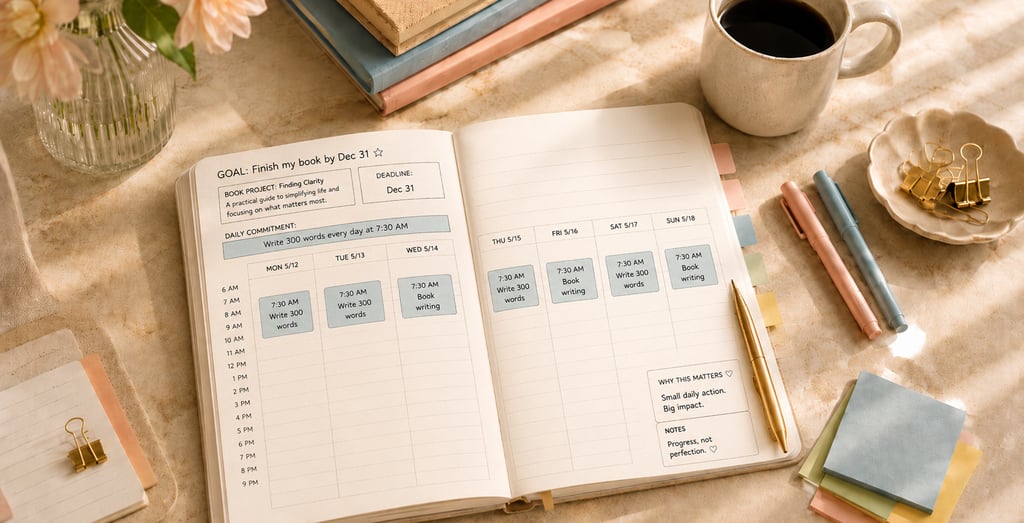
So: "I will write 300 words every weekday at 7:30 a.m." That's a goal with a calendar invite. We respect her.
Make it measurable - numbers are not bullying you
If you can't measure it, you can't manage it. You can only vaguely judge yourself in the shower, which helps no one.
"Save money" becomes: "I will save $500 by 30 June." "Work on my business" becomes: "I will publish two blog posts per week."
Numbers exist not to intimidate you, but to give your brain something concrete to work with. They show whether what you're doing is actually moving you forward. Progress you can't see feels like nothing, even when it isn't.
Stretch yourself, but don't be delusional about it
A good goal should make you slightly nervous. Not "quit by Thursday" nervous — just "this will actually require something of me" nervous.
Rate your confidence in achieving it from 1 to 10. A 3 means make it smaller. A 10 means you're probably not being ambitious enough. A 7 or 8 is usually where the interesting work happens.
Ambition is useful. Delusion is just admin you didn't plan for.
Check that it actually fits your life
A goal should serve your life, not someone else's aesthetic. Before you commit, ask: "Why does this matter now?"
If your goal is to wake up at 5 a.m. but you do your best work at night and have no actual reason to be up before the birds start gossiping — maybe the goal isn't discipline. Maybe it's performance art. There's no medal for doing things the hard way if the hard way doesn't lead anywhere useful.
Give it a deadline, or it's just a wish in lip gloss
A goal without a date floats around your life like an unpaid invoice you keep meaning to deal with.
Write: "By [date], I will [measurable result]."
"By 30 June, I will complete 12 workouts." "By 1 August, I will publish eight posts." "By Friday, I will apply for three roles."
Deadlines create shape. Without them, everything is "soon," and soon is where goals go to slowly become regrets.
Add an if–then plan, and remove the daily negotiation
This is the part most people skip, and it's the part that actually makes goals stick.
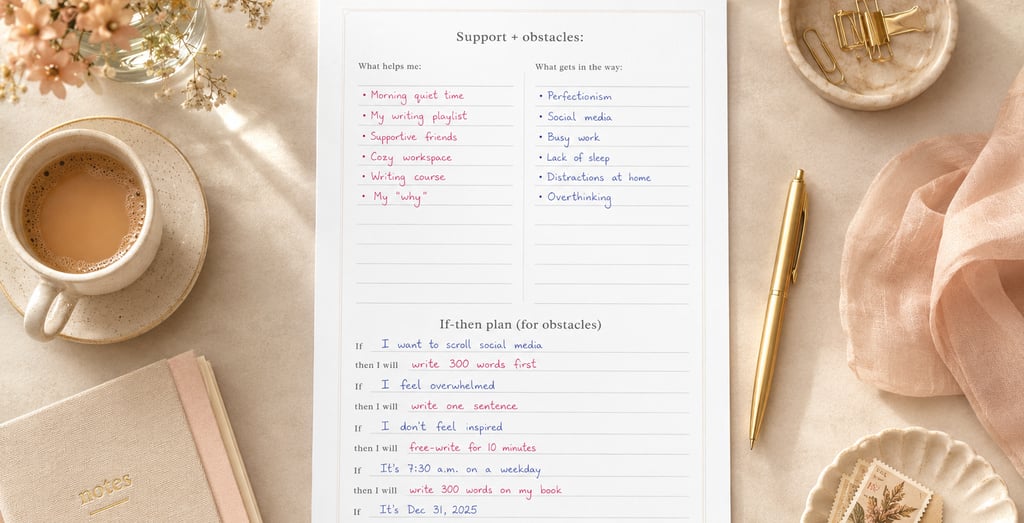
Don't just write: "I will exercise three times a week." Write: "If it's Monday, Wednesday, or Friday at 6:30 a.m., then I put on my workout clothes and do my 30-minute session."
This is called an implementation intention (yes, there's a name for it), and research reviewed by the National Cancer Institute found that if–then plans meaningfully improve follow-through by linking a situation to a specific action. In plain language: you're deciding in advance, so you don't have to negotiate with yourself when you're tired and your bed is warm.
Motivation is cute. She's just not reliable enough to depend on exclusively.
Plan for the thing that will definitely go wrong
You are not setting goals in a controlled environment. You're setting them inside a real life with work stress, bad sleep, unexpected expenses, other people's needs, and the occasional existential spiral over your morning coffee.
So plan for the obstacle before it shows up.
"If I'm too tired for the full workout, I'll do the 10-minute version." "If I miss my morning writing session, I'll write for 15 minutes after lunch." "If I feel overwhelmed, I'll do the smallest possible version of the task."
This isn't lowering your standards. This is building a goal with enough flexibility to survive an actual week. The backup plan isn't the failure mode — it's the thing that keeps you in the game.
Review it once a week — treat it like data, not a verdict
The goal isn't a New Year's resolution you write once and feel guilty about until March. Check in on it weekly.
Ask: Did I do the thing? What got in the way? Is the goal too big? Is the timing wrong? What's the smallest next step?
And here's the part people resist: changing the plan isn't failure. It's information. The goal is to figure out what actually works, not to prove you can suffer through a plan that clearly isn't working.
The full formula, if you want it clean
"By [date], I will [specific measurable result] by doing [repeatable behaviour] at/on [time/place/frequency]. If [obstacle or trigger], then I will [backup action]. I will review progress every [day/week]."
An example that's boring in the best way: "By 30 June, I will save $500 by transferring $125 every Friday after I get paid. If an unexpected expense comes up, I'll transfer at least $50 and adjust the next week. I'll review every Sunday."
That's a goal with a backbone. Not glamorous. Genuinely useful.
The goal isn't to become a perfectly optimised human spreadsheet. It's to stop giving your future self vague instructions and then acting surprised when she's confused and behind.
Make it specific. Make it measurable. Give it a deadline. Attach it to a real behaviour. Plan for the obstacle. Review it like someone who actually wants the outcome.
That's how a goal stops being a nice idea and starts being evidence.
Ready to stop writing goals on sticky notes and actually map them?
I built the Goal Mapping Portal exactly for this - a step-by-step process that takes everything above and walks you through it properly, so you leave with a real goal, a real plan, and no vague instructions for your future self to panic over.
Becky Boom
Printable planners, guided journals, and digital tools for turning vision into clarity, action, and evidence.
SHOP
© 2026 BeckyBoom. All rights reserved.
SUPPORT
EXPLORE